
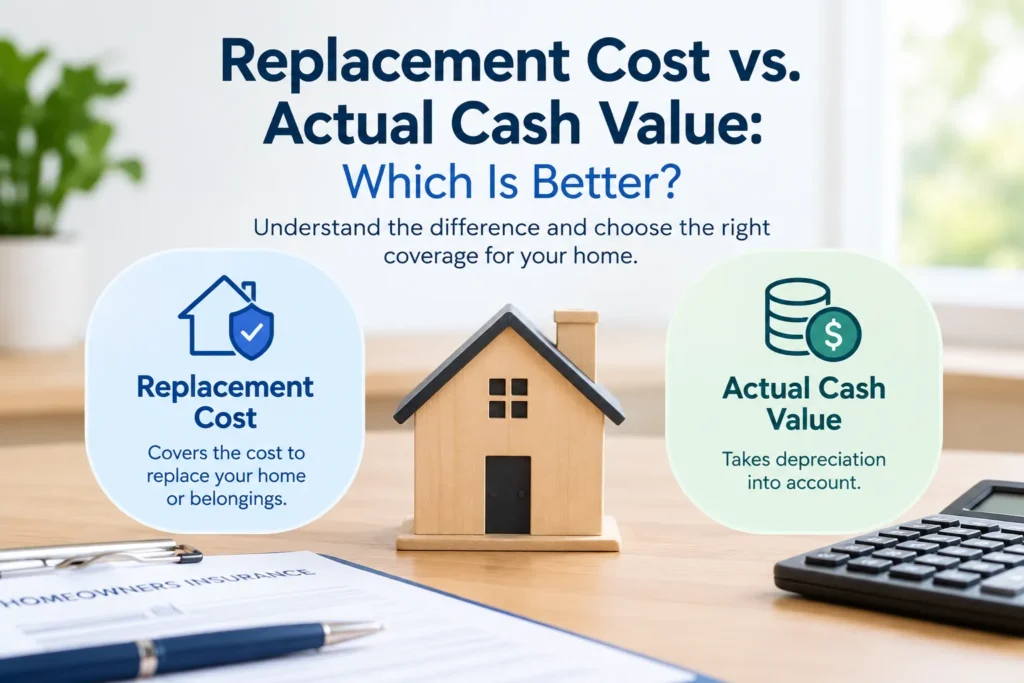
When selecting homeowners insurance, you’ll need to know what your insurance company will do if your home sustains damage. Replacement cost and actual cash value are two popular options. Understanding the difference between replacement cost vs. actual cash value can help you to decide what coverage is right for your budget and financial needs.
The difference between replacement cost coverage and actual cash value coverage is that the replacement cost coverage will generally pay out more in claims whereas actual cash value will have lower premiums but take into account depreciation.
What Is Replacement Cost Coverage?
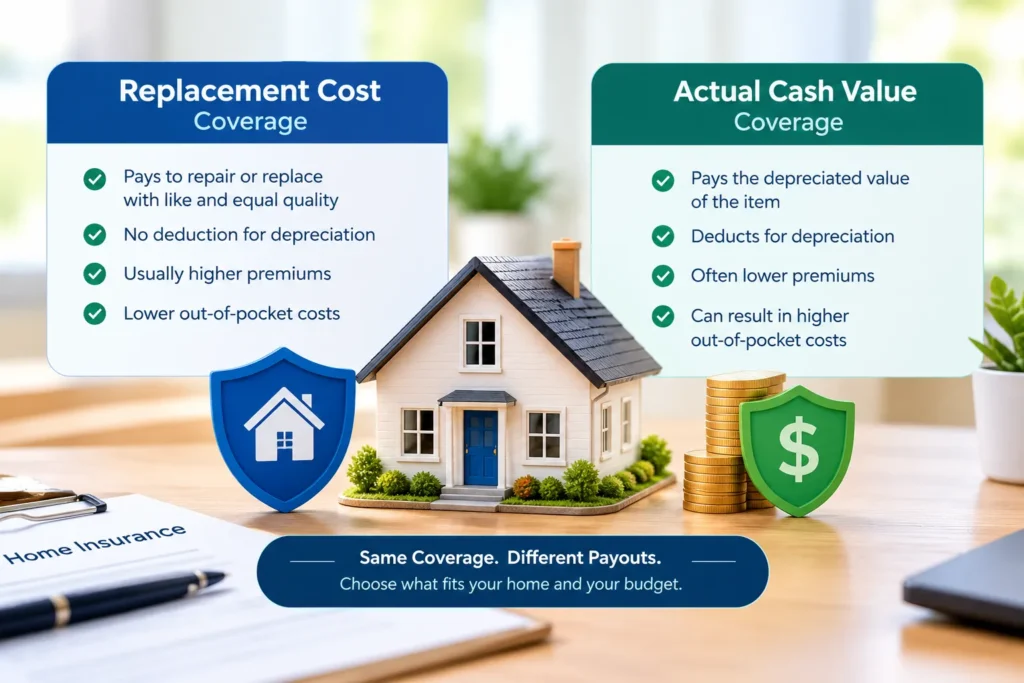
Replacement cost coverage is a coverage that will pay to replace the damaged property with a like and equal with no deductible for depreciation.
Dwelling replacement cost is the estimated value to replace your home’s structure. It takes into account the building materials, labour and building prices in the region, but not the market value of the property.
What Is Actual Cash Value Insurance?
The actual cash value insurance definition is the value of the property at the time of damage, minus any depreciation.
For instance, if the cost of replacement of a roof is $12,000 and depreciation is $4,000, its actual cash value might be $8,000. This means there will be a higher out-of-pocket repair cost.
Replacement Cost vs. Actual Cash Value: Key Differences
| Feature | Replacement Cost | Actual Cash Value |
| Depreciation | Not deducted | Deducted |
| Claim payment | Replacement expense | Depreciated value |
| Premium | Usually higher | Often lower |
| Out-of-pocket costs | Generally lower | Can be higher |
The final payment also depends on your deductible, policy limits, and covered losses.
How Depreciation Affects Home Insurance Claims
Home insurance deprecation takes into consideration an item’s age, condition and lifespan. It lowers their claim payment when they have the actual cash value coverage.
Some replacement cost policies pay for the actual cash value up front and then the balance if the vehicle is repaired. This is known as recoverable depreciation in homeowners insurance.
How to Choose the Right Coverage
Consider these factors before selecting a policy:
- Replacement protection: Choose replacement cost if you want to replace damaged property without a depreciation deduction.
- Lower premiums: Actual cash value may suit homeowners who can afford higher repair expenses.
- Personal belongings: Replacement cost coverage for personal property can help replace furniture, electronics, and other covered items.
- Coverage limits: Check your homeowners insurance replacement cost coverage limits to ensure they reflect rebuilding and replacement expenses.
- Rebuilding costs: The cost to rebuild a house for insurance should account for labor, materials, and local construction prices.
How Home Insurance Claim Settlements Work
Your home insurance claim settlement depends on your policy, deductible, damage assessment, and coverage type.
For example, an actual cash value roof insurance claim includes a depreciation deduction. Replacement Cost coverage can cover the eligible replacement cost, in stages, once repairs have been made.
Before making a claim, always check the conditions, exclusions and limits of roofs.
Conclusion
When comparing replacement cost vs. actual cash value, replacement cost generally provides stronger protection, while actual cash value can offer lower premiums. Make sure you understand your limits, deductible amounts and claim requirements to ensure the best protection for you and your home.
Frequently Asked Questions
Is replacement cost an improvement on actual cash value?
Replacement cost provides a more financial benefit since depreciation is not taken. This might be a better option in premiums to pay for actual cash value.
In what way do the two differ most?
Replacement cost pays you the replacement cost, and actual cash value takes off depreciation from the replacement cost.
Is depreciation considered part of the actual cash value?
Yes. When determining the value of an item it usually considers the age, condition, and wear of the item.
In a homeowners insurance policy, what does “recoverable depreciation” mean?
It’s the portion that is deducted from the first claim payment that can be issued once eligible repairs or replacement is done.
Do personal belongings compensate for replacement cost?
If your policy provides replacement cost coverage for personal property, then it can.
What does the cost of a house to be rebuilt consist of?
Square footage, materials, labor, construction features and local building costs are important factors insurers take into account.
Does actual cash value insurance cover damage to the roof?
Damage to the roof of a house can be insured, but any damages that are due to depreciation will be deducted from the payment. Roof-exclusive limits and exclusions are also possible.
May I be able to upgrade to replacement cost?
You might be able to modify your policy with your insurance company. Approval may be denied depending on eligibility and/or property conditions.
Do replacement cost policies have coverage limits?
Yes. Your policy will have maximum limits on your personal property and dwelling losses
Can I receive recoverable depreciation after repairs?
If your policy allows it, you may receive the withheld amount after submitting proof of eligible repairs within the required timeframe.